
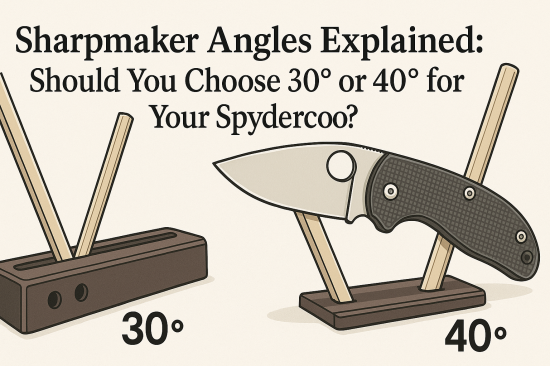
Sharpmaker Angles Explained: Should You Choose 30° or 40° for Your Spyderco?
By Logan M. Fraser – Custom Knife Modder & Spyderco Parts Specialist, Based in Calgary, Alberta, Canada
This is the 14th blog of the Spyderco Knife blog series. You can check the other blogs I’ve written here: https://spymodz.com/blogs
One of the most common sharpening questions I get from Spyderco owners is this: “Should I use the 30-degree or 40-degree setting on my Sharpmaker?” If you’ve ever wondered the same, you’re not alone. Choosing the right angle can affect not only your knife’s sharpness but also its edge retention and durability.
In this blog, I’ll break down both options, share what I recommend based on real-world use, and explain how to get the most out of your Spyderco Sharpmaker.
What Is the Spyderco Sharpmaker? ⚖️
The Spyderco Sharpmaker is one of the most beginner-friendly sharpening systems on the market. It includes two sets of ceramic rods and preset angle slots for:
30° inclusive (15° per side)
40° inclusive (20° per side)
You simply hold the blade vertical and run it down the rods at your desired angle. No clamps, jigs, or guesswork.
For more details on the system, visit https://spyderco.com and check their Sharpmaker page—it gives a great overview with setup guides.
What Does 30° Mean vs. 40°? 🔄
These numbers refer to the inclusive edge angle:
30° inclusive = 15° per side: Sharper, thinner edge, slices like a scalpel
40° inclusive = 20° per side: More durable edge, slightly less sharp
The angle you choose should depend on how you use your knife.
When to Use 30° (15° per side) 🌐
Choose 30° if you want:
Hair-popping sharpness
Clean food slicing performance
A razor edge for light tasks
This works great for:
EDC blades that see light use
Kitchen knives
Wharncliffe or leaf-blade Spydercos (like the SpydieChef)
⚠️ But beware: if you do heavy-duty work (cutting rope, wood, or boxes all day), that edge will degrade quickly. I recommend using the 30° back bevel to create a keen edge, then finishing with a micro-bevel at 40° for extra durability (Spyderco’s own method).
When to Use 40° (20° per side) 🪨
Stick with 40° if you need:
A tough, working edge
Less frequent sharpening
Better resistance to chipping or rolling
Ideal for:
Outdoor and bushcraft knives
Salt Series Spydercos (LC200N and H-1 steel hold up better this way)
Any folder that sees rough use or heavy cutting
Most factory Spyderco edges come close to 40°, so maintaining that angle gives consistent performance.
My Modder Recommendation 🧱
For most users, I suggest this hybrid approach:
Use 30° rods to create a back bevel (4–5 light passes)
Finish with 40° rods to set a micro-bevel (2–3 passes)
Why?
You get the sharpness of a finer edge with the durability of a steeper edge
It also makes touch-ups quicker in the future
This combo gives you a high-performance edge that won’t fail the moment you cut something tougher than paper.
Extra Tips for Sharpmaker Success 🚀
Use light, consistent pressure
Start with the gray medium rods, finish with the white fine rods
Clean the rods regularly to maintain performance (Bar Keepers Friend works well)
Mark your bevel with a Sharpie to make sure you’re hitting the edge
If you need to reset a badly damaged edge, the Diamond rods (sold separately) will save hours of time.
Want Sharpening-Friendly Parts? 🔧
Modding or upgrading your Spyderco? At https://spymodz.com, we stock compatible screws, backspacers, and hardware kits that make disassembly and maintenance easier—great if you’re sharpening frequently or swapping parts.
We also test every hardware kit on actual models to make sure your alignment and lockup stay tight after reassembly.
What the Community Says 😎
Browse https://forum.spyderco.com, and you’ll find strong support for both angles—with many seasoned users favoring the 30°/40° combo method.
This hybrid edge gives the best of both worlds: sharpness + real-world reliability.
Final Thoughts 🔪
If you’re still asking, “Should I use 30 or 40 degrees on my Sharpmaker?” the answer is: it depends on your usage. But in most cases, the 30° back bevel with a 40° micro-bevel is the sweet spot.
Have a question about angles, sharpening, or modding your Spyderco? Drop it in the comments below. And let me know what you’d like me to cover in next week’s Spyderco Knife Blog Series.